

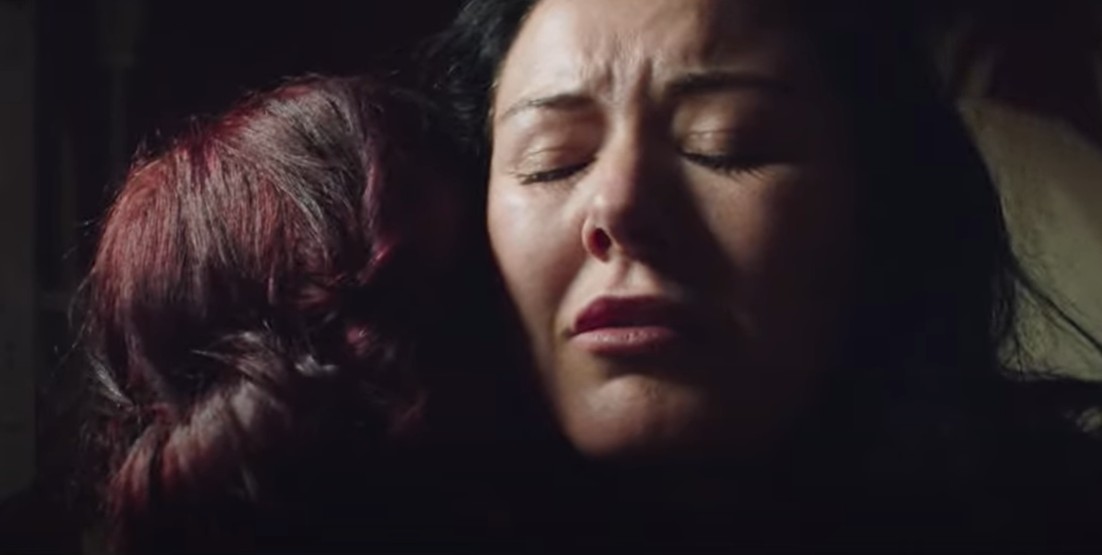
CIKÁDY VÝCHODU / Eastern Anthems (CA/US/EC, 2024)
Director: Matthew Wolkow, Jean-Jacques Martinod
The unfinished film is passed from one friend to another. The dialogue between them is a journey intersected by a swarm of American Great Eastern Generation X periodical cicadas, which appear prophetically every 17 years and prompt reflection on the post-pandemic present and our shared future. A film composed of a chorus of voices (both human and non-human), the warnings of history, the forces of nature and rebirth.
To wear your heart on your sleeve (FR/PS, 2025)
Director | Screenplay | Cinematography: Sepideh Farsi
To go with my soul in my hand is my answer – as a filmmaker – to the persistent massacre of Palestinians. My meeting with Fatem Hassona was a miracle. She became my eyes in Gaza, where she resisted and documented the war, and I became the link between her and the world from her „prison in Gaza,“ as she herself called it. We maintained this connection for almost a year. The fragments of sounds and pixels that we exchanged became the film you are watching.
Under Flags, Sun / Under the flags (Argentina/France/Germany/United States/Poland, 2025)
Directed by: Juanjo Pereira
Through rare and long-forgotten footage, this documentary
reveals the hidden mechanism of Alfred Stroessner's dictatorship in Paraguay – one
of the longest-lasting regimes in history. From propaganda to international
broadcasting unveils how media shaped power, controlled memory
and built a legacy that endures to this day.
The Flats (FR/BE/IE/UK, 2024)
Directed by: Alessandra Celesia
In his flat in a tower block in New Lodge, Joe relives childhood memories amid „The Troubles“. In this Catholic area of Belfast, the death toll was tragically high. Neighbours Jolene, Sean, Angie and others join Joe in voluntarily engaging in the process of re-experiencing shared memories that have shaped their lives and the neighbourhood they inhabit.
THE SENSE OF VIOLENCE (South Korea, 2025)
Director: Kim Mooyoung
The film traces the trajectory of cinema by uncovering specific connections within the historical context of „anti-communist art“ during the Park Chung-hee regime (1970s). The censorship of anti-communist film imagery by the Korean Central Intelligence Agency symbolically reveals the presence of power and ideology in the space between image and reality during Park's regime. Images reproduced by power through ideology depict reality, yet paradoxically interfere with it. For example, massacre scenes, which appear almost as cliché in anti-communist films, affect the reality experienced by the families of massacre victims, but it is often forgotten. The film also reflects on those who create these images. What role do creators play between power and ideology? Creators may collaborate with power, producing images that serve the ideology desired by those in power. At other times, they may passively document the images they observe, seemingly outside the sphere of power. However, even these seemingly neutral images are shaped by the omnipresent influence of power within a larger hierarchical structure.